
Baybayin Alphabet: Learn All 17 Characters
A clear, beginner friendly guide to the vowels, consonants, kudlit and virama, with a chart, a syllable builder and a step by step study plan.
What Is Baybayin and How Does It Work?
Baybayin is a pre-colonial Philippine writing system, not a language. It was used to write Tagalog and several other Philippine languages. The name comes from “baybay”, which means “to spell”.
It is an abugida, which means each character stands for a consonant plus a vowel, so you read it in syllables instead of single letters. That one idea explains almost everything on this page.
If you want to understand what each character actually means, keep reading.
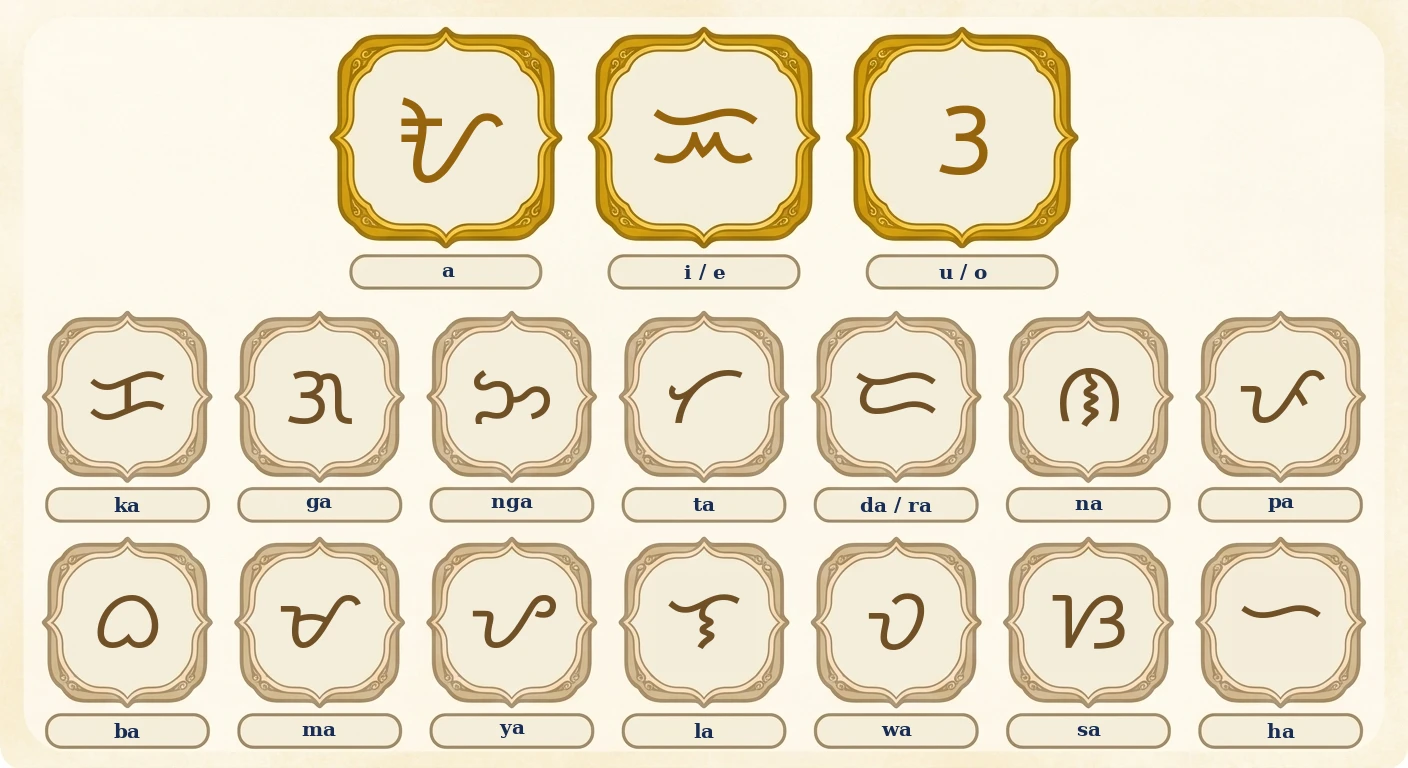
Baybayin Alphabet Chart: 3 Vowels and 14 Consonants
Here is every base character with its default sound. Highlighted cells are the vowels. You can select and copy these characters directly. When you want to see them used in a real word, the Baybayin Translator converts your text for you.
Baybayin vowels (patinig)
Vowels are written on their own only when a word starts with a vowel or a vowel stands alone inside a word. Otherwise the vowel comes from the consonant and its kudlit.
| Character | Sound |
|---|---|
| ᜀ | a |
| ᜁ | i / e |
| ᜂ | u / o |
Baybayin consonants (katinig)
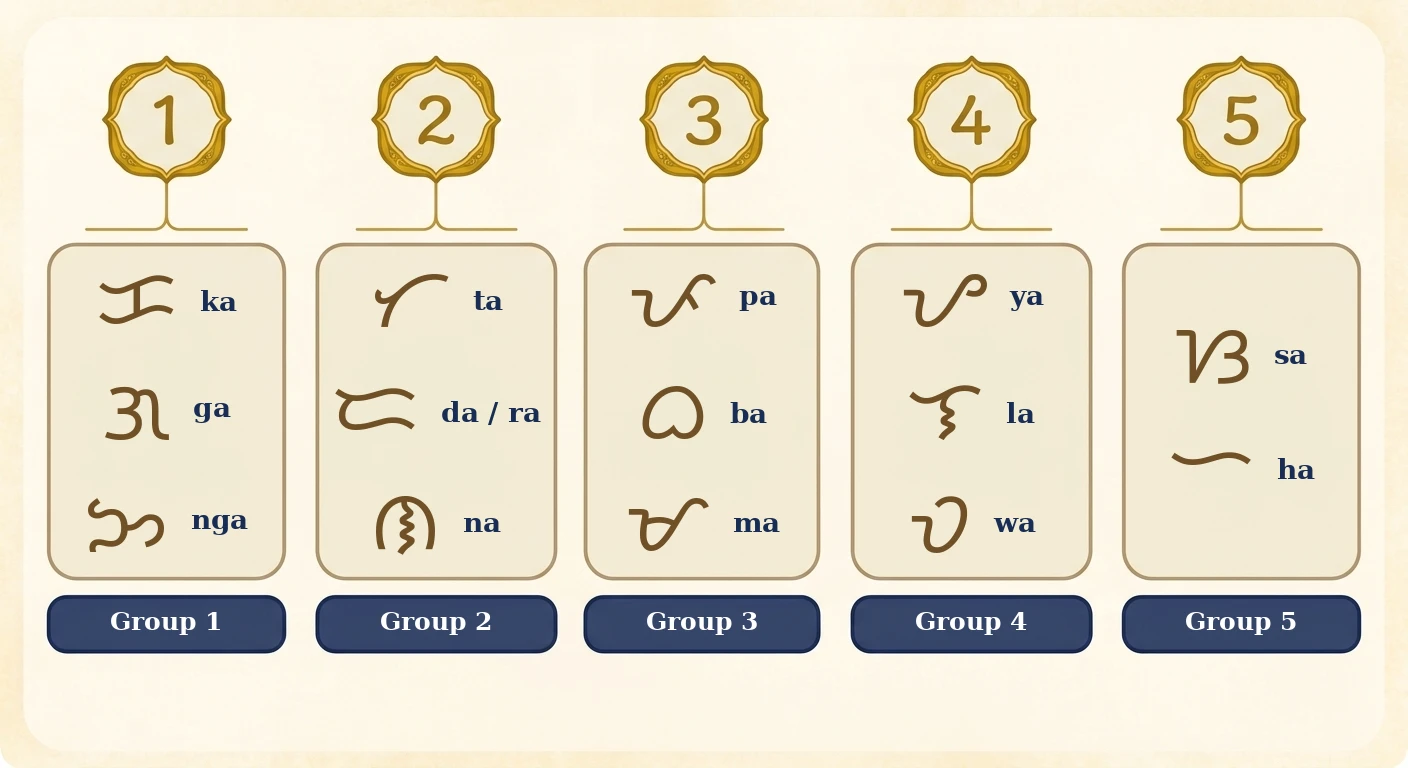
The 14 consonants are easier to remember in five small groups, which is also the order used in the study plan below.
| Character | Syllable | Note |
|---|---|---|
| ᜃ | ka | Also used for the hard “c” and “q” sounds in loanwords. |
| ᜄ | ga | |
| ᜅ | nga | Represents the “ng” sound as in “nga”. |
| ᜆ | ta | |
| ᜇ | da / ra | One character for both d and r. Read it as d or r from the word. |
| ᜈ | na | |
| ᜉ | pa | |
| ᜊ | ba | |
| ᜋ | ma | |
| ᜌ | ya | |
| ᜎ | la | |
| ᜏ | wa | |
| ᜐ | sa | |
| ᜑ | ha |
How the Kudlit Changes Every Baybayin Character
A kudlit is a small dot placed above or below a consonant. Above the character it changes the vowel to i or e. Below the character it changes the vowel to u or o. No mark means the default “a”.
| Mark | Position | Example with B |
|---|---|---|
| None | No mark | ba |
| Kudlit | Above | bi or be |
| Kudlit | Below | bu or bo |
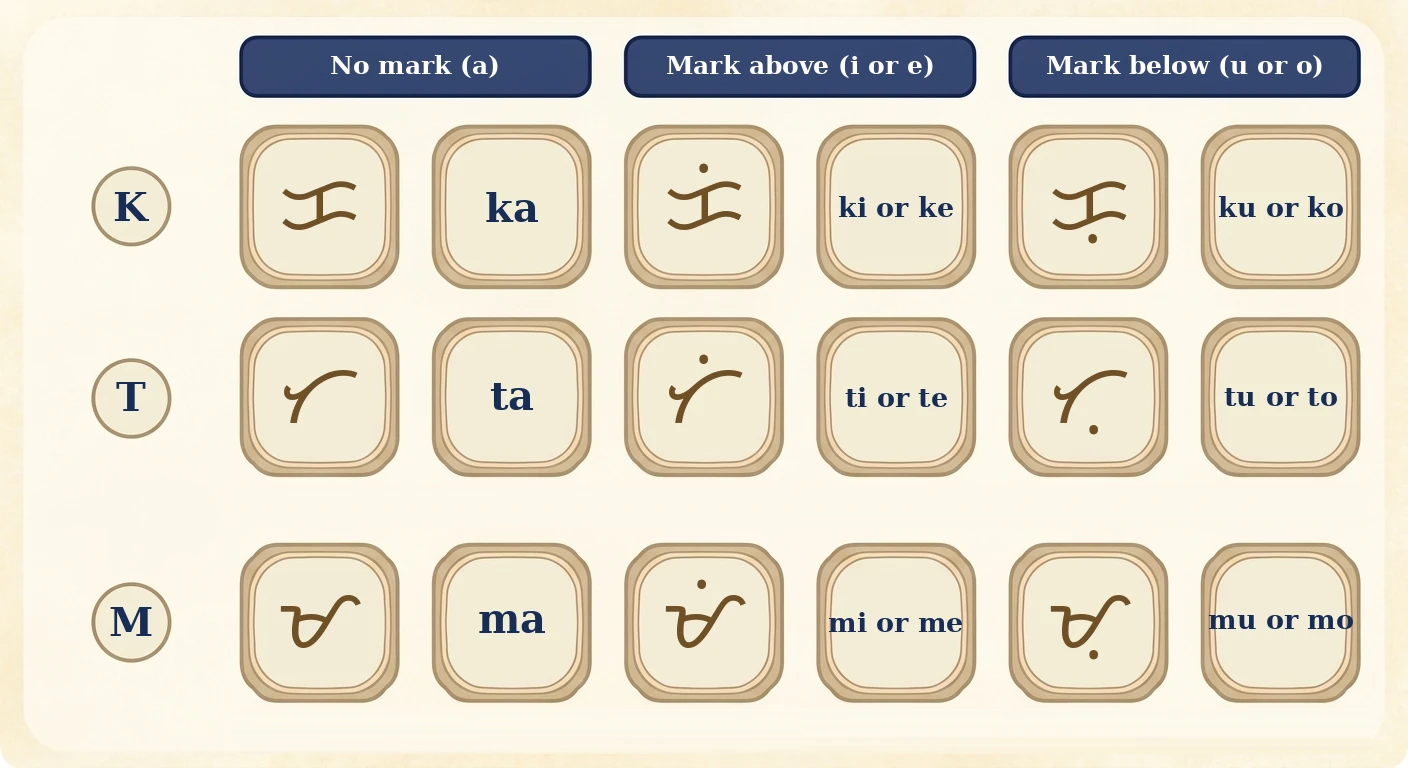
Why i and e share a mark
Baybayin did not separate i from e or u from o, because the languages it was built for treated them as close sounds. This is why a reading can have two possible spellings.
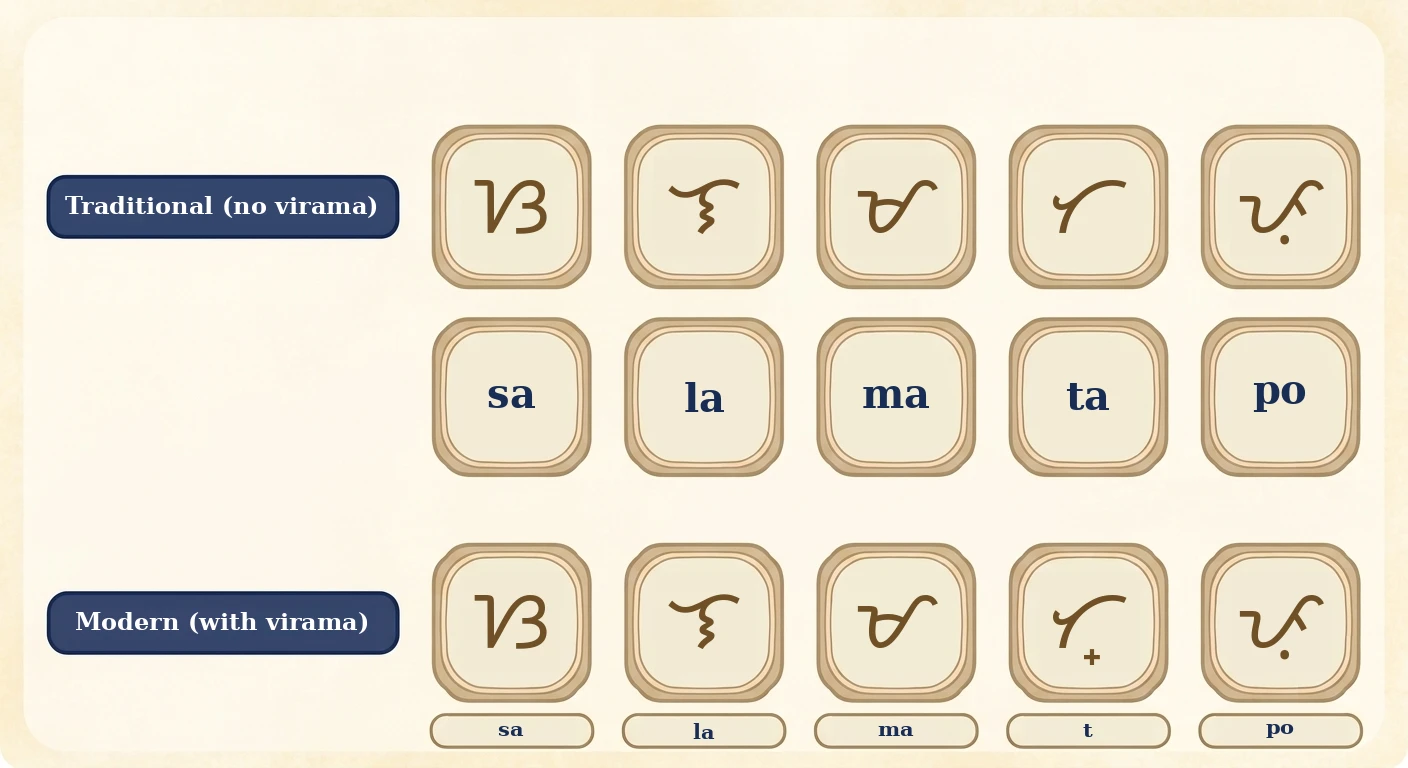
The Virama: Writing a Consonant Without a Vowel
Traditional Baybayin had no way to write a lone consonant, so final consonants were simply left out and readers filled them in from context. Spanish-era missionaries added a cross-shaped mark, now called the virama, to cancel the vowel. In modern writing it sits at the bottom of the character.
Compare the word salamat. Without a virama it can look like “salamata”. With a virama on the last character, the final “t” is clear.
Build Your Own Baybayin Syllables
Pick a consonant, choose a vowel option, and see the real character and its reading. Press “Add to word” to chain syllables together.
How to Learn Baybayin Step by Step
- Learn the three vowels. Say each one aloud: a, i or e, u or o.
- Learn the consonants in five groups. Group 1: ka ga nga. Group 2: ta da na. Group 3: pa ba ma. Group 4: ya la wa. Group 5: sa ha. Spend one session per group.
- Add the kudlit. Take any consonant you know and practice its three vowel forms.
- Add the virama. Practice dropping the final vowel in short words like mahal and salamat.
- Read real words. Start with two or three syllables, then check your answer with the Baybayin to Tagalog reader.
Writing direction
Modern Baybayin is written and read from left to right, one syllable after another, the same way you read the examples above.
Baybayin Letters Missing From A to Z
Baybayin does not have one character for every English letter. Sounds without their own character are approximated, and conventions vary between writers.
| Latin letter | Usually written with |
|---|---|
| E | The i / e character |
| O | The u / o character |
| F | Pa (or ha, depending on the writer) |
| V | Ba |
| Z | Sa |
| C, Q | Ka or sa, based on the sound |
Common beginner mistakes
- Reading a kudlit above as u, or below as i. The position decides the vowel.
- Forgetting that every consonant carries “a” unless marked.
- Expecting one correct spelling. Shared vowels and the shared d and r character allow more than one answer.
- Treating Hanunoo, Buhid or Tagbanwa as the same script as Baybayin.
“Alibata letters” is a common search for this same set of characters. Alibata is a twentieth-century name for Baybayin, so everything on this page applies.
Put the Baybayin Alphabet to Use
Now that you know the characters, the best way to remember them is to use them. Write your own words, read Baybayin you come across, or find out where the script’s names came from.